How to Plan Storage Without Adding Another Room
Before adding a store room, check what you need to keep, where you use it and how much space each storage choice takes from everyday life.
Before adding a store room to a home plan, list the actual things that need a place. For each one, note its size, where you use it and how often you take it out. Then test whether a cabinet, storage furniture or a separate room can hold it without taking away space you need for living or reaching other things. The best answer may use more than one of these options.
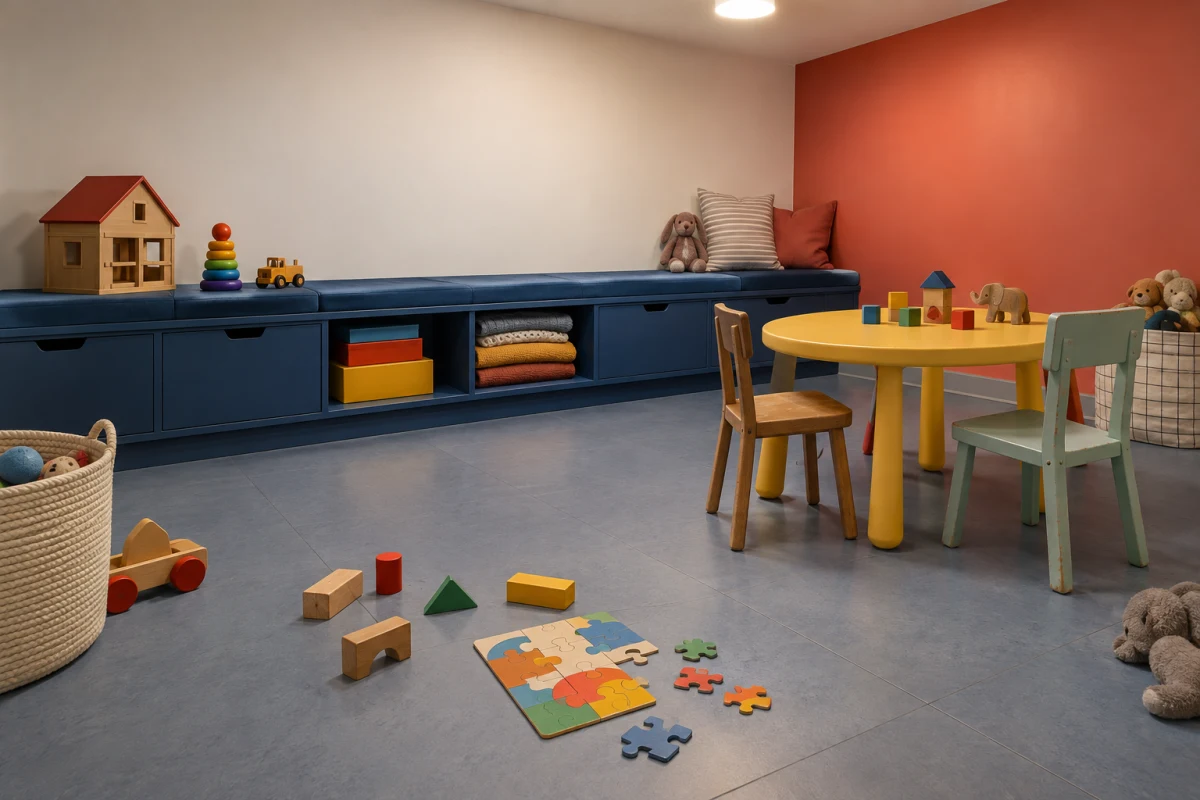
Illustrative playroom: a low storage bench keeps games and blankets near where they are used, leaving floor for play.
Start with belongings, not empty walls
Imagine a compact home where games and play blankets have no place in the child's play area. The vacuum and folding drying rack lean in another corner, while suitcases sit in a bedroom because nobody has chosen another place for them. It is tempting to add a store room to the plan. But these belongings do not all need the same location.
Make a short list of what has no home. Do not write only “cleaning supplies” or “seasonal things.” Write down the vacuum in its stored position, the folded rack, the actual suitcases and the boxes of games. Measure their outside dimensions, including handles or wheels that stick out. If you have not bought an item yet, keep a size range instead of pretending you know the exact model.
Next to each item, record how often it comes out and where it is used. A vacuum used across the home may need an easy route out. Games used in the play area are easier to return if storage is there. A suitcase used a few times a year can be farther away. These are choices for your household, not a fixed rule for every home.
Compare three places the items could go
Try the same list against three realistic options. On a plan, draw each option at its full outside size and note what it displaces. If the room is already built, mark the proposed footprint on the floor and try taking the real items in and out.
Freestanding furniture. A cabinet or chest can be moved or changed as your needs change. Check whether its depth takes away useful floor space, whether the contents fit and whether you can reach them where the furniture stands.
Built-in storage. A fitted unit can use a wall or recess whose shape is awkward for ready-made furniture. Check the internal space after the cabinet is built, whether the room still works comfortably and whether installation is feasible.
A separate store room. One enclosed place can hold several bulky or rarely used things together. Check how much floor is needed for shelves and a clear path to reach them, and which other room becomes smaller.
The playroom in the cover shows one possible low storage bench: games and blankets stay close to where they are used, and floor remains open for play. It is an illustrative room, not a dimensioned design. In your plan, the storage's actual depth and the items it must hold decide whether this works.
A separate room needs space to enter, not just space to stack
The store room below makes a different trade-off visible. Its shelving holds bins and spare linens; suitcases and a folded chair stand at the back. The central strip of floor is empty for a reason: someone needs it to enter and retrieve things. Filling that strip with more boxes would make the room look more capacious on paper while making its contents harder to use.
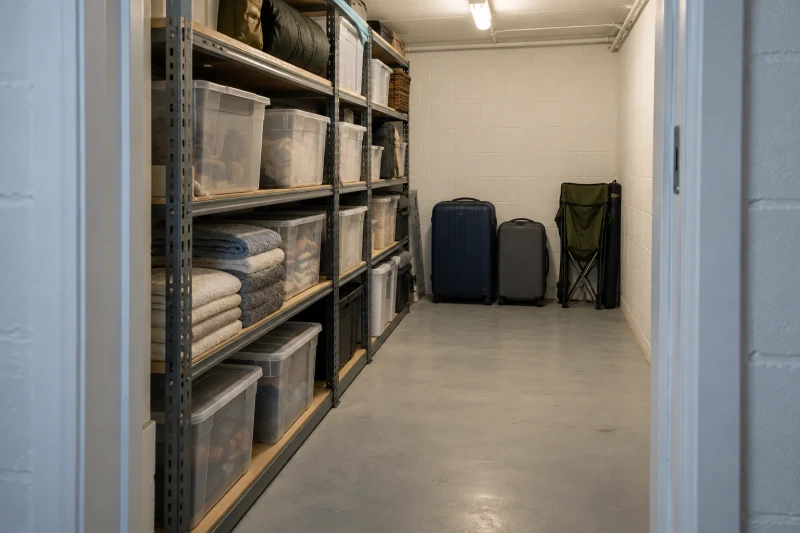
Separate illustrative store room: shelving gathers bulky, less-used items, but the central aisle must stay clear to reach them.
A store room may be worth its area when several bulky belongings need one enclosed place and the journey to it is acceptable. It may be a poor exchange if most of its contents are used daily in rooms far away, or if taking space for the store makes a bedroom, work area or sitting room harder to use. Compare the whole plan, not the storage room alone.
Choose a mix, then test the real use
For the example home, one option is to put games and blankets in the play-area bench, keep the vacuum and folded rack in a tall cupboard elsewhere, and place suitcases in an accessible but less central spot. Another is to group the bulky items in a small store room. Neither wins without checking the available dimensions and the room that gives up space.
Make two quick versions of your plan. Write each item next to its proposed place. For one normal day, trace where you would take out, use and put away the frequently used things; for an occasional day, try the suitcase or other bulky item. If you must move furniture or empty a shelf to reach something, that space is less useful than it first looked. Testing furniture at its real size can help you check a proposed cabinet or chest in the room around it.
Keep the option that gives your belongings a reachable place without sacrificing a more important use of the home. If fitted cabinets, heavy units or changes to walls are involved, check the chosen products and installation with the people responsible for the work. This planning test helps you choose a direction; it does not verify construction or local requirements.